
Wood Rot Around Windows: Causes Most Homeowners Miss
- Cajun Conservation
- Feb 2
- 4 min read


(And How to Fix It the Right Way in South Louisiana)
If you’ve noticed soft wood, peeling paint, or swelling trim around your windows — you’re not alone.
In South Louisiana, window wood rot is one of the most common problems homeowners face, especially in older homes.
And here’s the frustrating part:
✅ A lot of people replace the trim✅ Repaint everything✅ Caulk it up
…and the rot comes back.
That’s because the root cause is usually NOT the window itself — it’s the way water is getting behind the window area.
Let’s break it down in plain language.
First: What Does Wood Rot Look Like?
Rot around windows can show up as:
paint bubbling or peeling near the window
wood that looks “puffy” or swollen
cracking caulk lines
black stains in corners
soft spots you can press with a finger
spongy trim when tapped
trim pulling away from the wall
ants or insects showing up (they love soft wood)
If you catch it early, it’s usually a manageable repair.If ignored, it can spread into the wall framing.
The #1 Truth: Rot Usually Comes From Water Intrusion
Wood doesn’t rot just because it’s old.
It rots because:✅ water gets in✅ it can’t dry out✅ the cycle repeats
In Louisiana, the humidity makes drying slower, so even small leaks can cause long-term damage.

Most Common Causes of Window Rot (That People Miss)
1. Failed Caulk (But Not Just “Old Caulk”)
Yes, caulk matters — but the bigger issue is why the caulk failed.
Caulk fails faster when:
the joint moves a lot (wood expansion)
the wrong caulk was used
it was applied to dirty/wet surfaces
the gap is too large
it was painted too soon
If the caulk joint opens up, water slips behind the trim.
✅ Fix: proper joint prep + correct caulk + correct gap strategy(Not just smearing more over the top.)
2. No Proper Window Flashing
This is one of the biggest hidden causes.
A window should have flashing that directs water outward, not inward.
If flashing was skipped or installed wrong:
water enters behind siding/trim
wood stays damp
rot starts slowly and spreads
✅ Fix: repair with correct flashing, not cosmetic trim replacement
3. Water Is Getting In From Above the Window
Rot at a window doesn’t always mean the window is leaking.
Water can travel from:
roof flashing problems
fascia/soffit leaks
siding above the window
a crack higher up the wall
Then it shows up at the window area because it’s a weak point.
✅ Clue: staining above the window or on the wall nearby
4. Window Sill Holds Water (Bad Drainage)
Window sills fail when they act like a shelf that holds water.
Common issues:
flat sill with no slope
no drip edge underneath
water sits and soaks in
In Louisiana, that wet wood gets baked, then wet again — over and over.
✅ Fix: rebuild/repair sill with slope + drip strategy
5. End Grain Wood Exposure
This one is sneaky.
Wood soaks up water fastest through end grain (the cut ends).
Common spots:
bottom corners of window trim
sill ends
joints where trim pieces meet
If those ends aren’t sealed correctly, they become little moisture sponges.
✅ Fix: seal end grain + prime correctly + protect with proper detailing
6. Hardie / Siding Gaps and Bad Transitions
Window rot can start because siding and trim details weren’t done right.
Examples:
siding cut too tight
no clearance where needed
gaps left open
missing flashing behind trim
caulk used as the only defense
✅ Fix: correct spacing, sealing, and water management behind the finish
7. Condensation From Inside (Not Rain)
Some windows rot from the inside out.
This happens when:
indoor humidity is high
the wall is poorly insulated
air leaks bring humid air into cooler areas
condensation forms behind trim or near window edges
This is common in:
older homes
rooms with poor airflow
bathrooms near windows
homes that “feel damp inside”
✅ Fix: humidity control + sealing + insulation strategy
How to Tell If It’s “Minor Trim Rot” or Bigger Wall Damage
Here’s a simple homeowner check:
✅ Likely minor:
rot only in the outer trim
framing feels solid
damage is localized
caught early
⚠️ Could be bigger:
soft drywall inside near the window
stains spreading
window feels loose
insects present
repeated repairs over the years
wood is soft deeper than 1/2"
If it’s deeper than surface trim, it may involve:
sheathing repair
framing repair
a flashing rebuild
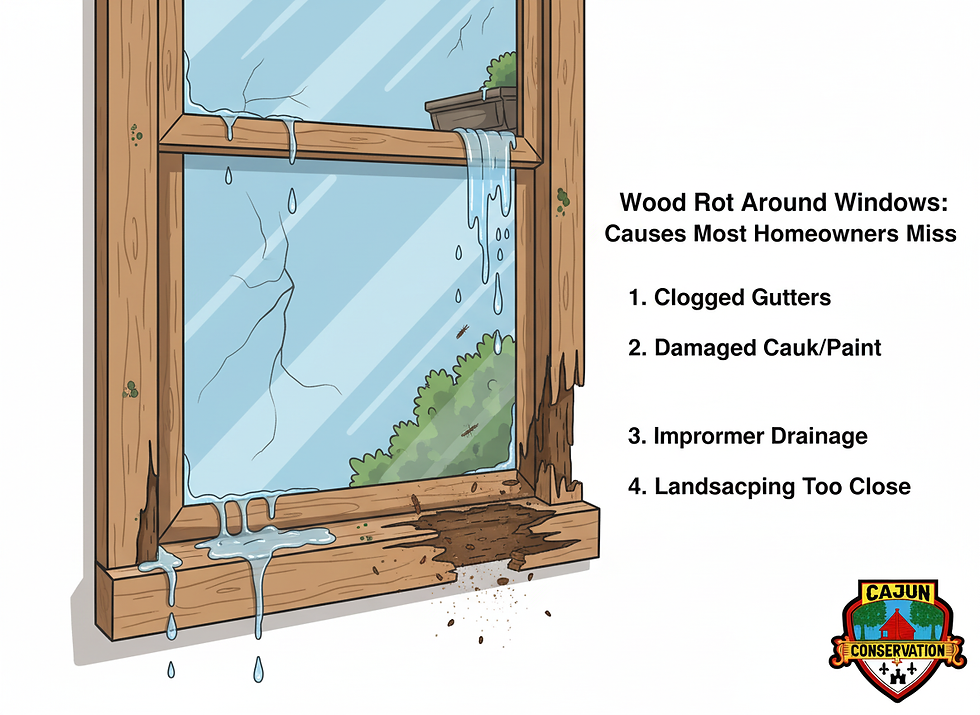
The Wrong Way to Fix Window Rot
A lot of “repairs” fail because they’re only cosmetic:
❌ scrape + paint❌ add caulk everywhere❌ replace only the visible trim❌ cover soft wood with filler and paint it
That usually lasts short-term — then water gets back in.
The Right Way to Fix Window Rot
A lasting repair typically involves:
✅ removing damaged wood✅ identifying how water is entering✅ repairing flashing/water paths✅ rebuilding trim correctly✅ sealing end grain and joints✅ priming properly✅ repainting with the right system
Done right, you’re not just making it pretty — you’re stopping the rot cycle.
Why This Matters Before You Remodel
Window rot is often a sign of broader moisture behavior.
If you remodel finishes without fixing intrusion:
new trim can rot too
paint fails again
insulation can get damaged
mold risk increases
That’s why good remodelers don’t just “dress up” the problem.
Need Window Repairs That Hold Up in Louisiana?
At Cajun Conservation, we handle remodel work across South Louisiana with a focus on:
moisture-resistant details
older home realities
craftsmanship that lasts in this climate
Question for you:Is the rot happening mostly on the bottom corners, the sill, or around the top of the window frame?


Comments