
Floors Buckling or Cupping in Summer — Why It Happens
- Cajun Conservation
- Feb 2
- 4 min read


(And What South Louisiana Homeowners Should Do About It)
If your floors start doing weird things in the summer — you’re not alone.
In South Louisiana, many homeowners notice:
wood floors “cupping” (edges raised)
boards swelling and tightening up
planks pushing up or buckling
gaps disappearing (or showing up later)
floating floors shifting or popping
It can be scary, especially if the floor was expensive or “not that old.”
But here’s the truth:
✅ Most summer floor problems are moisture-related✅ They’re often preventable✅ And the real fix isn’t always replacing the flooring
Let’s break it down in plain language.
What Does “Cupping” or “Buckling” Mean?
Cupping
Cupping is when the edges of a board rise up and the center dips.
It often looks like the floor is slightly wavy.
Buckling
Buckling is more extreme — the floor lifts up and creates a hump or raised area.
This can be caused by swelling, pressure, or lack of space for expansion.
The #1 Cause: Moisture
Floors almost always buckle or cup because of moisture imbalance.
In South Louisiana, moisture comes from:
high indoor humidity
crawl space moisture (raised homes)
slab moisture (if vapor barrier is weak or missing)
plumbing leaks
water intrusion near doors/windows
wet mopping / spills that soak in
AC not removing humidity properly
Even when there’s no “flood,” moisture can still build up over time.

Why This Happens More in Summer
Summer means:
higher humidity
more rain
hotter temperatures
AC cycles that may not dehumidify enough
Wood expands when it absorbs moisture.
If it swells and has nowhere to go, it will:
push against other boards
push against walls
lift, buckle, or deform
Common Floor Types That Get Hit Hardest
✅ Solid hardwood
Beautiful, but very sensitive to humidity swings.
✅ Engineered wood (can still move)
More stable than hardwood, but not immune.
✅ Laminate / floating floors
They don’t like moisture underneath and can “tent” if expansion space is tight.
✅ Luxury vinyl plank (LVP)
Better with moisture, but can still ripple or move if the subfloor shifts or humidity is extreme.
✅ Tile floors (different problem)
Tile doesn’t expand like wood, but moisture movement below can cause:
cracked grout
loose tiles
tenting in rare cases
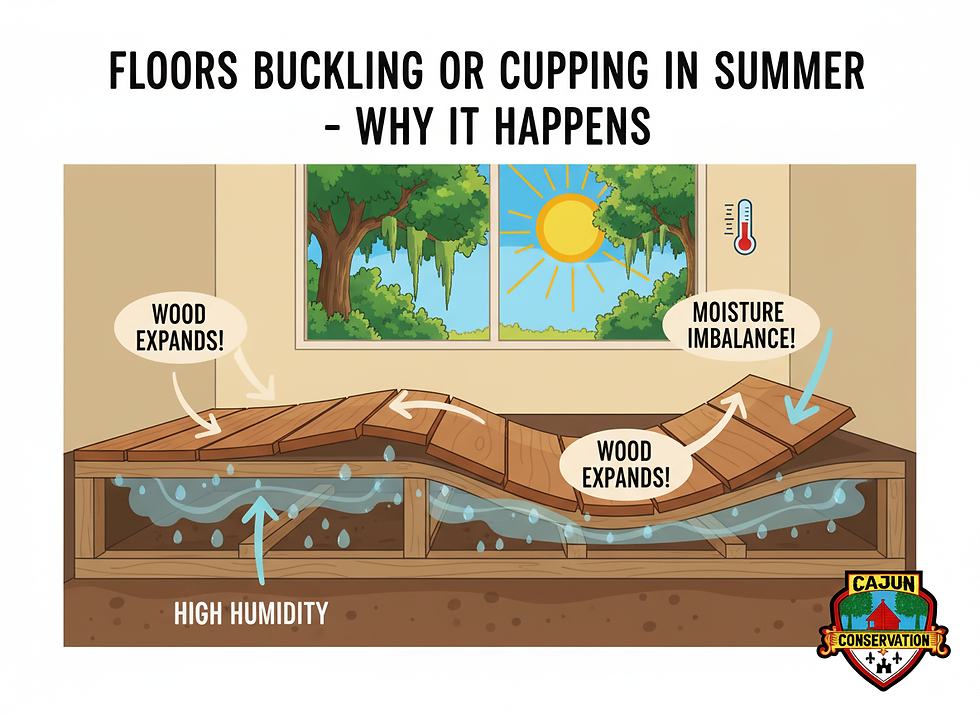
Most Common Reasons Floors Cup or Buckle
1. High Indoor Humidity
If your house feels “sticky” even when cool, that moisture is working on your floors.
✅ Clue:
the problem is widespread, not just one spot
A humidity meter can help confirm it.If your indoor humidity stays above 60%, you’re in the danger zone.
2. Crawl Space Moisture (Raised Homes)
This is huge in South Louisiana.
If the crawl space stays damp, moisture rises into:
joists
subfloor
flooring
✅ Clue:
cupping is worse near exterior walls
musty smell is present
floor feels soft in some places too
3. Moisture From a Slab (Slab Homes)
Slabs can transmit moisture upward, especially if:
vapor barrier is missing or failing
drainage around the home is poor
water collects near the foundation
✅ Clue:
problems are worse in one section of the home
flooring was installed directly on slab without proper underlayment
4. Not Enough Expansion Gap
Floors need room to expand.
If the installer didn’t leave enough space around edges, the floor may push and buckle.
Common causes:
flooring tight to the wall
baseboards pinning the floor
heavy cabinets installed over floating floors
flooring “locked in” by transitions
✅ Clue:
buckling or tenting occurs in the middle of rooms
5. A Hidden Leak
A small leak under a fridge, sink, or toilet can cause localized buckling.
Common leak spots:
dishwasher
fridge water line
toilet wax ring
tub drain
under-sink supply valves
washing machine overflow
✅ Clue:
problem is concentrated in one area
floor feels softer there
staining appears later
6. Wet Mopping / Cleaning Habits
This doesn’t happen to everyone, but it’s real.
Too much water + wood floors over time = swelling.
✅ Tip:Use damp mop methods designed for the flooring type — not soaking wet cleaning.

What NOT to Do
These moves often make it worse:
❌ Don’t sand hardwood immediately
If the moisture problem isn’t fixed, it will return.
❌ Don’t replace the floor before solving moisture
New floors will fail too.
❌ Don’t ignore it
Buckling can stress boards and joints permanently.
❌ Don’t run AC colder and colder
Sometimes colder air makes a humid house feel worse (clammy).
What Actually Fixes It (Long-Term)
The correct fix depends on the source, but these are the usual winners:
✅ Find and stop any leaks first✅ Measure indoor humidity and bring it down✅ Improve ventilation or dehumidification✅ Correct crawl space moisture issues✅ Check expansion gaps and flooring lock points✅ Fix drainage issues around foundation
Sometimes floors improve once conditions stabilize — especially cupping.
Buckling usually requires more repair.
How to Prevent It Before a Remodel
If you’re planning a remodel in South Louisiana and flooring is part of the project:
Do this first:✅ address moisture behavior✅ confirm subfloor condition✅ correct ventilation/humidity issues✅ choose flooring that fits your home type
A remodel isn’t just about looks — it’s about building something that holds up here.
Need Help Diagnosing It Before You Spend Money?
At Cajun Conservation, we remodel and repair homes across South Louisiana and we always look at:
moisture behavior
subfloor and framing condition
long-term durability in our climate
Question for you:Is your floor issue happening all over, or mostly near a bathroom/kitchen/exterior wall?


Comments