
Why Caulk and Paint Fail Faster in Humid Climates
- Cajun Conservation
- Feb 2
- 4 min read


(What South Louisiana Homeowners Should Know Before a Remodel)
If you live in South Louisiana, you’ve probably dealt with this:
caulk cracking way too soon
paint peeling on trim
gaps reappearing after “fresh work”
mildew stains in corners
joints separating even after you fixed them
And it’s frustrating because you might think:
“I literally just caulked/painted that.”
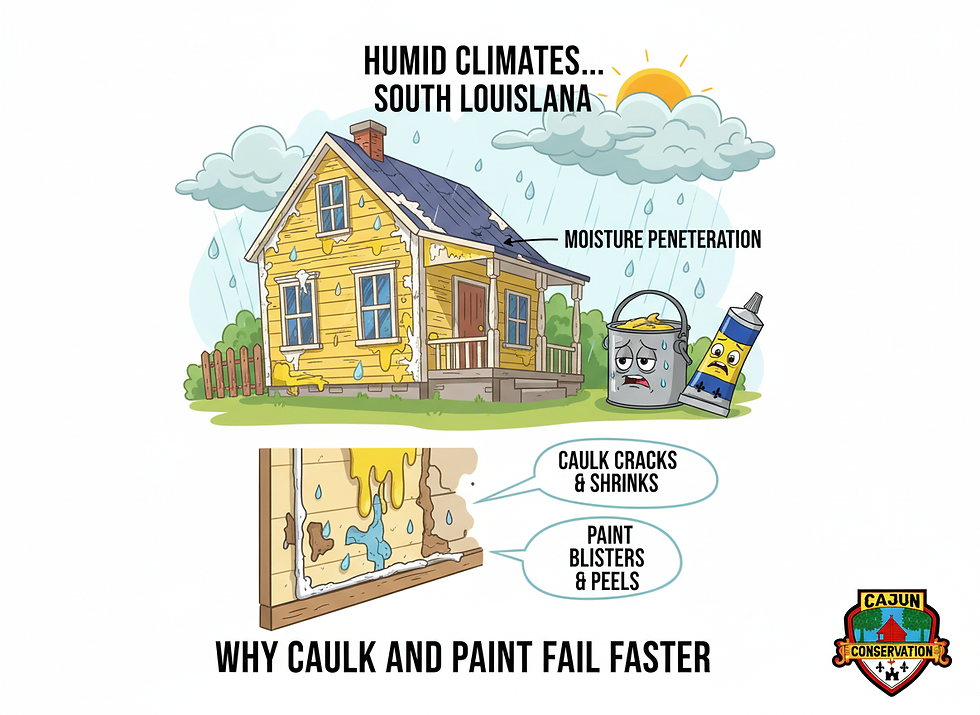
The truth is:In humid climates, caulk and paint don’t just fail because of time…They fail because of movement + moisture + the wrong products or details.
Let’s break it down so you understand what causes it and how to stop it.
Why Caulk and Paint Matter More Than People Think
Caulk and paint aren’t just cosmetic — they’re part of your home’s protection system.
They help block:
water intrusion
air leaks
pests
rot and mold development
heat and humidity infiltration
So when they fail early, it’s not just ugly — it can lead to expensive repairs.
The 4 Main Reasons Caulk and Paint Fail Faster in South Louisiana
1. High Humidity = More Wood Movement
Wood absorbs moisture from the air.
When it absorbs moisture, it swells.When it dries out, it shrinks.
This constant cycle causes:
trim seams to open
joints to shift
caulk lines to stretch and crack
paint film to split at corners
In Louisiana, these cycles happen constantly.
✅ Result: even “perfect looking” joints can fail if the home is moving.
2. Heat + Sun = Faster Breakdown
Exterior surfaces get baked here.
Heat and UV exposure cause:
caulk to dry out faster
paint to chalk and fade
joints to become brittle
adhesion failure over time
South- and west-facing walls often fail first.
✅ Result: the same paint job can last 10+ years elsewhere… but 5–7 here.
3. Moisture Gets Behind the Paint / Caulk
The most important truth:
Caulk and paint are not waterproof armor if water is getting in from behind.
Common ways moisture gets behind finishes:
failing window caulk
missing flashing
siding gaps
poor trim details
roof/wall entry points
crawl space humidity rising into walls
Once moisture is behind the paint, you’ll see:
bubbling
peeling
mildew
soft wood
recurring rot
✅ If you keep fixing the surface, it keeps coming back.
4. Wrong Products or Wrong Application
This is extremely common and totally avoidable.
Caulk fails early if:
the wrong type is used
the joint is too wide
it’s applied to dusty or damp surfaces
it’s painted before curing
it’s used to “fill carpentry gaps” that should’ve been fitted correctly
Paint fails early if:
surface wasn’t cleaned/deglossed
wrong primer was used
paint was applied too thick
wood wasn’t sealed properly
paint was applied in poor weather conditions
✅ Result: the job looks good for a short time, then breaks down.
Common Places Caulk and Paint Fail First
If you want to predict where problems will show up, check these areas:
✅ Around windows
Water entry + sun exposure + movement = high failure zone.
✅ Exterior door trim
High movement + air leaks + exposure.
✅ Siding seams & trim transitions
If flashing is missing, caulk becomes the only defense (bad situation).
✅ Bathroom corners
Moisture + poor ventilation = repeated cracking/mildew.
✅ Crown molding / ceiling corners
Movement makes these seams show up quickly.
What Homeowners Often Get Wrong (No Shame, It’s Normal)
❌ “I’ll just add more caulk”
Too much caulk can trap moisture and fail worse.
❌ “If I buy the most expensive paint, it’ll last”
Paint quality matters, but surface prep and moisture control matter more.
❌ “That gap is small, it’s fine”
Small gaps become water paths in Louisiana.
❌ “Everything can be fixed with caulk”
Caulk is not carpentry. It’s a sealant, not structural filler.
How to Make Caulk and Paint LAST Longer Here
If you want your work to hold up in South Louisiana, focus on these principles:
✅ 1. Fix water intrusion first
If water is getting behind trim, no caulk or paint will win long-term.
✅ 2. Use the correct caulk for the job
You want:
flexible
paintable
strong adhesion
designed for exterior or high-moisture zones
(And you want it applied correctly.)
✅ 3. Fit the carpentry properly
When trim is installed tight and correctly:
caulk lines can be thinner
joints move less
finish looks better longer
✅ 4. Prime correctly (especially bare wood)
Primer choice matters more than most homeowners realize.
✅ 5. Respect cure times and conditions
Humidity and rain timing are a big deal here.Rushing finish work ruins longevity.

Why This Matters Before a Remodel
Early caulk and paint failure is often a warning sign that:
moisture is getting in somewhere
wood is moving more than expected
the last remodel was rushed
the home needs a better moisture strategy
If you remodel without fixing it, you get:
new finishes failing early
trim gaps returning quickly
recurring paint problems
rot returning around openings
A good remodel should reduce maintenance, not increase it.
What a “Louisiana-Proof” Finish Looks Like
A finish that lasts in South Louisiana usually includes:
✅ good prep✅ proper carpentry fitment✅ correct flashing and water shedding details✅ flexible sealants where needed✅ proper primers✅ correct paint system✅ moisture control strategies
This is why craftsmanship matters here more than almost anywhere.
Need It Done Right the First Time?
At Cajun Conservation, we remodel and repair homes across South Louisiana with a focus on:
durability in humidity
older home realities
high-level carpentry and detail work
finish systems that hold up
Question for you:Do you see caulk/paint failures mostly outside around windows, or inside at trim corners and bathrooms?


Comments